HISTORY
If monuments were the glory of the Egyptian Old Kingdom (2675 – 2130 BCE) and conquest was the glory of the New Kingdom (1550 – 1070 BCE), then the glory of the Middle Kingdom (2030 – 1650 BCE) was its literature. They range from fiction (“The Tale of the Shipwrecked Sailor” and “The Story of Sinuhe”) to wisdom literature (“The Instructions of Ptahhotep and Kagemni”).
But I think the most fascinating and modern-feeling work from that time was the book “The Dispute Between A Man And His Soul (Ba)”. This is a fascinating debate between a man and their immortal soul. Since this is ancient literature, we only have an incomplete manuscript that is missing the beginning.
This is a profoundly Egyptian text. The references to “The West” in this document are references to the land of death. The probable reason why they associated the West with the land of the dead is the great Western desert (the Sahara) that lay to the west of the Nile. It was literally a place where very little could live.
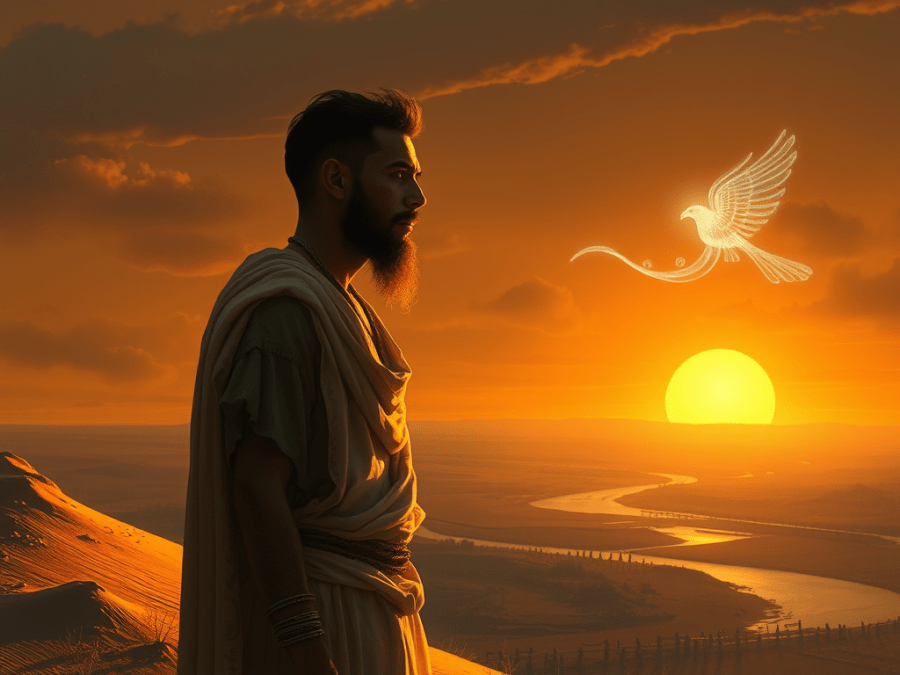
Indeed, the Egyptians buried their dead on the west bank of the Nile so the spirits could see the sun raise in the east.
This dispute is between a man who wants to die and his soul that urges him to live. Given this, there is a trigger warning for this document. But it is something I have found very formative to my own spiritual development, and I wanted to share this with you.
…I opened my mouth to my soul, that I might answer what it had said. I said, “This is too much for me today, that my soul no longer talks with me. It’s really too great to be exaggerated! My soul is abandoning me. Don’t let my soul go away! It should wait for me because of. . . .
I have modernized the dialogue from an older 19th Century English translation that leans too heavily on King James Bible language. The meaning is the same. The ellipses indicate a missing word or phrase.
For ease of reading the dialogue, the man’s words are in black and the soul’s words are in red.
THE DISPUTE BETWEEN A MAN AND HIS SOUL (BA)
“There is no competent person who flees on the day of misfortune. My soul wrongs me, but I do not listen to it! I want to drag myself toward death before my time and cast myself upon the fire to burn myself up. . . . May it be near to me on the day of misfortune and wait on that side. . .
“My soul is stupid to try to win over me, who is wretched over life, and delay me from my death before I come to it. Make the West pleasant for me! Is that so bad? Life is a restricted period: even the trees must fall. I trampled down wrongs—yet my wretchedness endures! Let Thoth, who soothes the gods, judge me. Let Khonsu, the scribe in truth, defend me. Let Re, who pilots the sun barque, hear my speech. Let Isdes, who vindicates the deceased, defend me. My wretchedness is heavy. . . . Pleasant would be the defense of a god for the secrets of my body.”
What my soul said to me: “Are you not a man? Are you. . .while you live? What is your goal? You are concerned with burial like a rich person!”
I said: “I have not left so long as these things are neglected. He who carries off people will take you without caring about you, like any criminal, saying, ‘I will carry you off, because your fate is still death, even though your name may live.’ But the West is a place for setting down the guide of the heart. The West is my true home. . . . If my soul will listen to me, an innocent man, and its heart agrees with me, it will be fortunate.
“Then I will make my spirit reach the West like one who is in his pyramid, at whose burial a survivor has stood. I will make a shelter over my corpse, so that you may scorn another soul as inert. I will make a shelter—now it must not be too cool—so that you can scorn another soul which is too hot. I will drink at the watering place and will feast, so that you can scorn another soul which is hungry.
“If you delay me from a death in this fashion, you will not find a place where you can settle down in the West. So be patient, my soul and my brother, until my heir has appeared; he who will make offerings and will stand at my grave on the day of burial, so that he may prepare the bed of my rest.”
My soul opened its mouth to me, that it might answer what I had said: “If you are thinking of burial, that is your heart’s distress. It is a bringer of tears, making a man sad. It is taking a man out of his house, so that he is left on the hillside, when he will never go up above that he might see the sun.
“Take they who build in granite and who hew out chambers in a pyramid (good men in good work). As soon as the builders have become gods, their offering stones are bare for the lack of a survivor. Or take the weary ones, the dead in the dyke—the waters make an end of them, and the sunlight as well, and the fish of the water banks talk to them. Listen to me! It is good for men to listen. Pursue the happy day and forget care!
“A poor man plows his plot of ground and loads his harvest into a ship’s hold. He makes the journey by towing their boat, because his feast day is fast approaching. When he sees the coming of an evening of high water, he is vigilant in the ship when Re retires. And so he comes out safely with his wife. But say his daughter is lost on the lake, which is treacherous with crocodiles in the night. At last he sits down, when he can say: ‘I am not weeping for that girl, although there is no coming forth from the West for her for another time on earth. But I am concerned about her unborn children, broken in the egg, who saw the face of the crocodile god before they had even lived!’
“The poor man asks for an afternoon meal, but his wife says to him: ‘It’s for supper!’ He goes out-of-doors to grumble for a while. If he comes back into the house and is acting like a new man, his wife still experienced him as he was: he doesn’t listen to her but grumbles, and is unresponsive to her communications.”
I opened my mouth to my soul, that I might answer what it had said:
“Behold, my name will reek through thee
More than the stench of bird-droppings
On summer days, when the sky is hot.
Behold, my name will reek through thee
More than a fish-handler
On the day of the catch, when the sky is hot.
Behold, my name will reek through thee
More than the stench of bird-droppings,
More than a covert of reeds with waterfowl.
Behold, my name will reek through thee
More than the stench of fisherman,
More than the stagnant pools which they have fished.
Behold, my name will reek through thee
More than the stench of crocodiles,
More than sitting in the assembly among the crocodiles.
Behold, my name will reek through thee
More than a married woman
Against whom a lie has been told because of a man.
Behold, my name will reek through thee
More than a sturdy boy of whom it is said:
“He belongs to his rival!”
Behold, my name will reek through thee
More than a treacherous town, which plots rebellion,
Of which only the outside can be seen.***
To whom can I speak today?
One’s fellows are evil;
The friends of today do not love.
To whom can I speak today?
Hearts are rapacious:
Every man seizes his fellow’s goods.
To whom can I speak today?
The gentle man has perished,
But the violent man has access to everybody.
To whom can I speak today?
Even the calm of face is wicked;
Goodness is rejected everywhere.
To whom can I speak today?
Though a man should arouse wrath by his evil character,
He only stirs everyone to laughter, so wicked is his sin.
To whom can I speak today?
Men are plundering;
Every man seizes his fellow’s goods.
To whom can I speak today?
The foul friend is an intimate,
But a brother, with whom one worked, has become an enemy.
To whom can I speak today?
No one thinks of yesterday;
No one at this time acts for him who has acted.
To whom can I speak today?
One’s fellows are evil;
One has recourse to strangers for uprightness of heart.
To whom can I speak today?
Faces have disappeared:
Every man has a downcast face toward his fellows.
To whom can I speak today?
Hearts are rapacious;
No man has a heart upon which one may rely.
To whom can I speak today?
There are no righteous;
The land is left to those who do wrong.
To whom can I speak today?
There is lack of an intimate friend;
One has recourse to an unknown to complain to him.
To whom can I speak today?
There is no one contented of heart;
That man with whom one went, he no longer exists.
To whom can I speak today?
I am laden with wretchedness
For lack of an intimate friend.
To whom can I speak today?
The sin which treads the earth,
It has no end.Death is in my sight today
Like the recovery of a sick man,
Like going out into the open after a confinement.
Death is in my sight today
Like the odor of myrrh
Like sitting under an awning on a breezy day.
Death is in my sight today
Like the odor of lotus blossoms,
Like sitting on the bank of drunkenness.
Death is in my sight today
Like the passing away of rain,
Like the return of men to their houses from an expedition.
Death is in my sight today
Like the clearing of the sky,
Like a man fowling thereby for what he knew not.
Death is in my sight today
Like the longing of a man to see his house again,
After he has spent many years held in captivity.Why surely, he who is yonder
Will be a living god,
Punishing a sin of him who commits it.
Why surely, he who is yonder
Will stand in the barque of the sun,
Causing that the choicest offerings therein be given to the temples.
Why surely, he who is yonder
Will be a man of wisdom,
Not hindered from appealing to Re when he speaks.“Then my soul said to me, “Set mourning aside, my brother who belongs to me! Although you be offered up on the brazier, yet you will cling to life, as you say. Whether it be desirable that I remain here because you have rejected the West, or whether it be desirable that you reach the West and your body join the earth, I will come to rest after you have relaxed in death. Thus we will make a home together!”
It has come to its end, its beginning to its end, as found in writing.
 The BIGGEST minutiae